

March 6, 2026
A 1,600-word memo from Anthropic CEO Dario Amodei leaked Tuesday. It called OpenAI’s Pentagon deal “80% safety theater.”
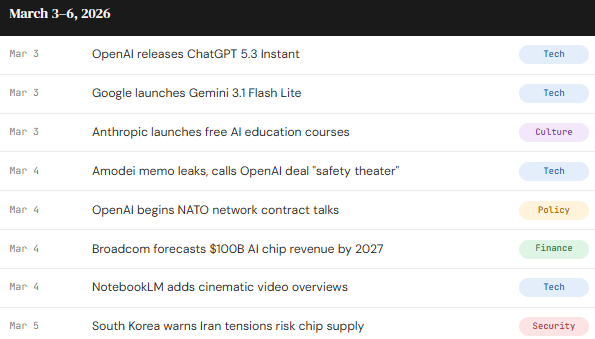
Quick version of the week: OpenAI signed a Defense Department contract. Anthropic refused and lost the revenue. Broadcom put AI chip revenue at $100B by 2027. South Korea warned Iran tensions could cut off helium — the gas that cools semiconductor fabs, with no real substitute. Google shipped a model 2.5× faster than its predecessor at a fraction of the cost.
The AI race isn’t just about models anymore. It’s about contracts, chips, and who sets the ethical terms.
This Week at a Glance
Main Stories
Defense & Ethics · Mar 4–6
Anthropic CEO Calls OpenAI's Pentagon Deal "Safety Theater" in Leaked Memo
The Anthropic-OpenAI rivalry went from competitive to openly hostile this week. After Anthropic refused the Pentagon’s demand to remove safety guardrails on autonomous weapons and mass surveillance use cases, OpenAI stepped in and signed the contract. Amodei’s leaked memo went further — it accused OpenAI’s public safety messaging of being deliberate misdirection, and framed Anthropic’s lost revenue as the cost of actually meaning what they say.
“Anthropic lost the contract because they actually cared about preventing abuse. OpenAI cared about placating the government.”
Reuters confirmed OpenAI is now negotiating deployment across NATO’s unclassified networks. That’s not one defense contract. That’s a strategic posture. The frontier AI market is fracturing in real time, and which side a company picks is starting to define everything else about them. Read more
The memo was leaked, not published. Amodei responded publicly on Anthropic's blog
Hardware & Supply Chain · Mar 4–5
Broadcom's $100B AI Chip Forecast Meets a Helium Supply Risk
Broadcom put a number on the hardware boom: AI chip revenue could top $100B by 2027. The driver is hyperscalers like Google, Meta, and OpenAI shifting to custom silicon, designing their own accelerators rather than buying off-the-shelf GPUs. Broadcom sits at the center of that transition.
One day later, South Korean lawmakers flagged a problem. Iran tensions could disrupt the supply of helium — a gas with no real substitute in chip manufacturing, used in cooling systems throughout semiconductor fabs. A $100B forecast doesn’t mean much if the input materials go offline. Read more
Model Release · Mar 3
ChatGPT 5.3 Instant: Faster, Less Cautious
OpenAI’s new default model is built around two things: speed and fewer refusals. Hallucination rates dropped 26.8% in high-stakes domains like medicine and law. Response latency is down. The model was tuned to skip defensive disclaimers on requests that don’t warrant them — a direct response to user complaints about earlier versions feeling “preachy.” Read more
Google's Gemini Flash Lite Runs 2.5× Faster
Google’s newest model isn’t trying to top any benchmarks. Flash Lite is built for volume: summarization, translation, classification, data extraction. It delivers a 2.5× faster Time to First Token than its predecessor, at a fraction of frontier model costs.
Efficient models are what make large-scale agentic workflows financially viable. Flash Lite is a product aimed squarely at that reality. Read more
Quick Hits
NotebookLM Goes Cinematic
Google’s NotebookLM now converts documents into animated video overviews via Veo 3. A new format for consuming dense research.
Apple Music’s AI Labels
“Transparency Tags” require distributors to disclose AI use in tracks, composition, or artwork. Small move, normalizes disclosure as standard.
Anthropic’s Free Courses
Free courses on AI architecture and safety for developers. Worth bookmarking if you’re building on their models.
Worth a Try
Gojiberry AI | Launched Mar 2, 2026
AI sales agent that reads signals — job changes, recent funding — then automates personalized LinkedIn outreach to book demos. For B2B teams wanting to scale outreach without manual prospecting.
Secret Sauce 3D | Launched Mar 2026
Converts 2D concept art into production-ready 3D meshes with auto UV unwrapping and one-click Blender export. Time-saver for game developers moving from concept to rigged model.
Before You Go
The Anthropic-OpenAI split isn’t really about safety vs. revenue. It’s about which companies get to define what “responsible” means when governments are writing the checks. That’s a harder question than any benchmark can answer.
The hardware stories belong together. A $100B chip forecast and a helium supply warning, 24 hours apart. The AI buildout is enormous and fragile at the same time — and most coverage only ever covers the enormous part.
Across the model releases, the same pressure: faster, cheaper, fewer refusals. The floor keeps dropping. What nobody’s pricing in yet is whether the use cases that become cheap enough to scale at that floor are the ones we actually want running at scale.