

February 14, 2026
The era of the “one model does everything” is over. Google bet on depth. OpenAI bet on speed. Anthropic raised $30 billion to bet on both.
Before you shut down your computer for the weekend, consider this: For three years, the industry chased one idea: a single AI that is faster, smarter, and cheaper than everything else. The model that does it all.
This week, that idea died. And that’s a good thing.
This Week at a Glance
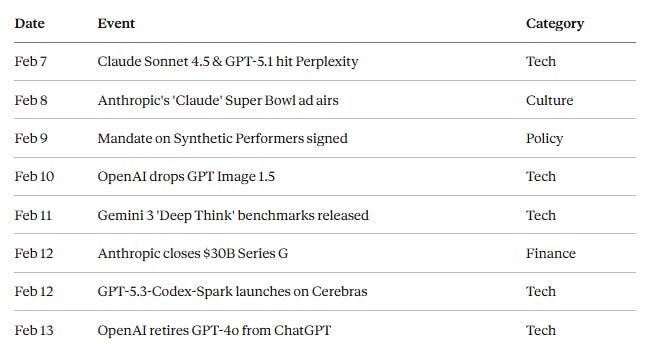
Google and OpenAI Are Building Two Very Different Futures
Google DeepMind dropped Gemini 3 Deep Think, a model that reasons before it responds. The results are wild: 84.6% on ARC-AGI-2, a benchmark where most LLMs barely crack 30%. It also hit “Legendary Grandmaster” on Codeforces with an Elo of 3,455.
This model thinks like a principal engineer, not an intern.
OpenAI went the opposite direction. GPT-5.3-Codex-Spark runs on Cerebras chips (not Nvidia GPUs) and generates 1,000+ tokens per second. Built for speed, it lets developers interrupt and redirect the AI mid-thought. The trade-off? Lower scores on complex benchmarks than its slower sibling.
Takeaway: The future is a stack. Fast models for 90% of routine work, deep-thinking models for the hard 10%.
Anthropic Just Raised $30 Billion
Anthropic closed its Series G at a $380 billion valuation, led by Singapore’s GIC and Coatue, with Amazon, Microsoft, and Nvidia participating. Revenue hit $14 billion annualized, a 10x jump in three years.
Training the next generation of frontier models costs an estimated $10-20 billion per run. Only mega-labs and nation-states can afford that ticket. The “Big Three” (OpenAI, Google, Anthropic) have officially left everyone else behind. source
Stripe’s AI Agents Ship 1,000+ Code Changes Weekly
Stripe revealed that its internal AI system, “Minions,” merges over 1,000 pull requests every week. No human writes or tests the code. An engineer sends a Slack message, the agent codes, runs tests, iterates, and submits the finished PR for review.
The secret wasn’t a better model. It was better infrastructure: standardized cloud environments where every developer (human or AI) works the same way. source
Claude’s New Plugins Crashed Legal Tech Stocks
Anthropic released Claude Cowork plugins for legal, sales, and data workflows. The market reaction was brutal. Thomson Reuters and RELX (LexisNexis) saw intraday drops of 14-18%.
The message from investors: if a general-purpose AI can review contracts and flag risks with a plugin, the $500/month vertical SaaS tool starts looking overpriced. Value is shifting from the app layer to the model layer. source
Open-Source Agent OpenClaw Triggers International Bans
China and South Korea banned OpenClaw this week after security firms found infostealers disguised as productivity plugins. The agent runs locally with deep system permissions, making it a supply chain nightmare.
The irony? The US usually blocks AI exports to China. Now Asian governments are blocking Western open-source AI imports. source
Quick Hits
US regulation showdown: The Trump administration launched a DOJ task force to preempt state AI safety laws, teeing up a Commerce Clause vs. 10th Amendment fight.
UK bans “AI Lawyers”: Courts now require strict human verification on all legal filings.
Super Bowl AI backlash: Viewers called it “AI fatigue” after wall-to-wall ads from Anthropic, OpenAI, Google, and Meta.
OpenAI’s internal leak hunt: A custom ChatGPT tool now scans employee Slack and email to identify leakers within minutes.
Rentahuman.ai: A platform where AI agents hire humans for physical tasks. Over 26,000 people have signed up to work for bots.
GPT-4o retired: OpenAI officially pulled the model from ChatGPT. End of an era.
Geopolitics: The Treaty That Wasn’t
A sobering note from the global stage.
The Event: The REAIM Summit (Responsible AI in the Military Domain) in Spain.
The News: Both the United States and China refused to sign the declaration to constrain military AI.
The Implication: The two superpowers have effectively signaled that they will not handicap their military algorithms. We are entering an era of unconstrained algorithmic warfare, driving mid-sized nations (like those in the EU and India) to scramble for their own “Sovereign AI” capabilities to protect themselves.
Takeaway
The tools are getting sharper. One set is becoming a scalpel (Deep Think), the other a power drill (Codex Spark). Your job next week isn't just to "use AI"—it's to know which tool to pick up.