

February 20, 2026
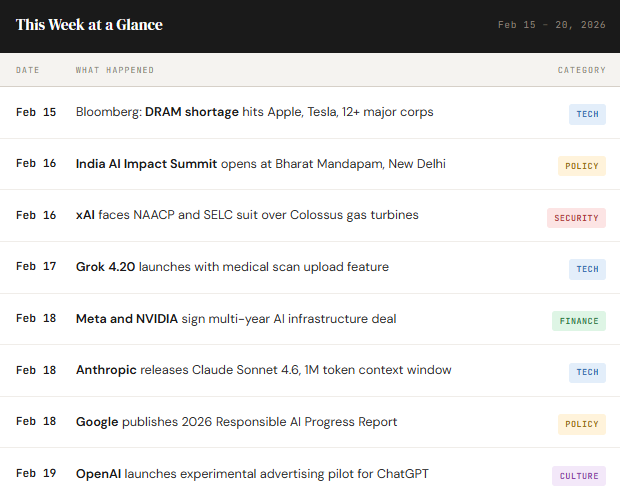
New Delhi basically became the AI industry's annual meeting this week. Every major lab CEO flew in. Twenty heads of state showed up. Meanwhile, back home, Apple told investors a global memory shortage will squeeze iPhone margins. Micron called it "unprecedented." Tesla floated building its own memory fabrication plant. Meta and NVIDIA locked in a multi-year supply deal. Anthropic dropped its second major model in two weeks, same price as the last one.
The software layer is moving faster than ever. The physical layer beneath it is starting to crack.
Chips, memory, geography, power. Those are the real chokepoints now. The deals signed this week will matter more than any benchmark that dropped.
Main Stories
Every Major Lab CEO Flew to New Delhi. India Is No Longer a Future Market.
The India AI Impact Summit ran February 16 to 20 at Bharat Mandapam. The attendance list: Sam Altman, Sundar Pichai, Dario Amodei, Jensen Huang, and Demis Hassabis, alongside Modi, Macron, and 20+ other heads of state. India put 38,000 GPUs into public compute access, set aside $1.1 billion for a state-backed AI venture fund, and said its first commercial-scale semiconductor production starts this month. Adani pledged $100 billion for renewable-powered AI data centers by 2035. Altman said ChatGPT now has 100 million weekly active users in India. Second-largest market in the world, after the US.
This was also the first global AI summit to be hosted in the Global South. That matters. The countries that got left out of writing earlier internet-era rules are not going to let that happen again. The summit dropped the word "safety" from its framing entirely. The new word is "impact." That shift tells us something about where the conversation is heading.
The Memory Wall: Apple, Tesla, and Micron Are All Flashing the Same Warning.
A global DRAM shortage is already hitting more than a dozen major companies. Apple CEO Tim Cook told investors it will compress iPhone margins this year. Micron called it “unprecedented.” Elon Musk said the situation is bad enough that Tesla is looking at building its own memory fabrication plant. That’s a multi-billion dollar call normally made by chipmakers, not car companies.
This one is worth sitting with. AI ate the memory supply. Now that shortage is showing up in iPhones, Teslas, and server farms at the same time. That’s not a niche supply chain problem. That’s the whole consumer tech stack under pressure at once.
Meta and NVIDIA Lock in Supply Before the Squeeze Gets Worse.
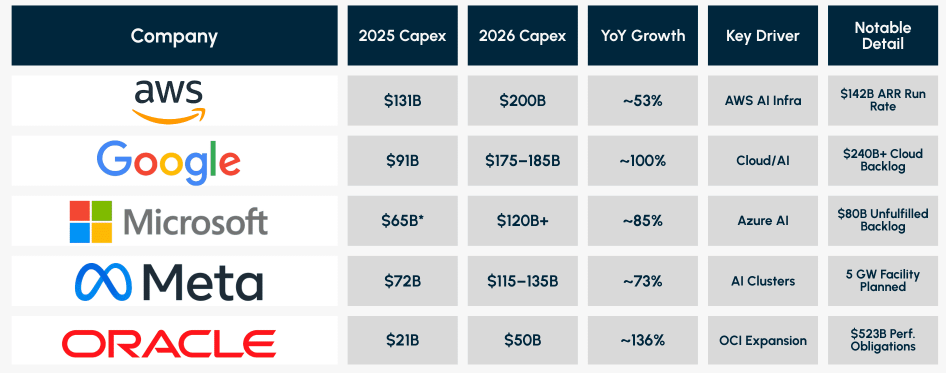
Meta and NVIDIA announced a multi-year strategic partnership covering AI training, inference, and NVIDIA’s next-generation Vera Rubin platform. The deal includes Confidential Computing for WhatsApp, keeping user data private while enabling AI features at scale. Tech giants collectively are on pace to spend close to $700 billion on AI infrastructure in 2026 alone.
Long-term supply agreements like this are less about innovation and more about hedging. With DRAM scarce and compute demand rising, locking in supply now is the same logic energy companies use to secure fuel contracts before a shortage peaks.
Anthropic Ships Frontier Intelligence. Same Price as Last Week.
Claude Sonnet 4.6 came out Tuesday. Second major model release from Anthropic in under two weeks. It runs close to Opus quality, the most capable tier they make, at the same price as the last Sonnet. The context window is 1 million tokens, which is big enough to hold an entire codebase or a lengthy contract in a single go. Early users are calling out real improvements in financial analysis, frontend coding, and computer use tasks. Form-filling. Spreadsheet work. Things that used to need a human in the loop.
Shipping near-flagship capability at the same price is a move aimed directly at the other labs. Someone at OpenAI, Google, and Mistral read this announcement and had a bad Tuesday.
Quick Hits
ChatGPT Gets Ads
OpenAI launched an experimental advertising program this week. Major brands have already joined the pilot. A clean, no-ad experience was part of what made ChatGPT feel different. Worth watching how users respond.
xAI Faces Environmental Suit
The NAACP and SELC filed a notice of intent to sue xAI over unpermitted gas turbines at the Colossus data center in Memphis. If this moves forward, it could slow the infrastructure that runs Grok.
India’s First Chip Fab
India’s IT Secretary said the country’s first commercial-scale semiconductor production starts this month. If it actually delivers on schedule, the supply chain math for the region starts to look different.
MCP Goes Open Standard
Anthropic handed the Model Context Protocol to the Linux Foundation this week. OpenAI, Microsoft, and Google are all on board. Agents from different companies can now talk to each other without a corporate middleman.
Grok 4.20 Reads Your X-Rays Now
xAI released Grok 4.20 on February 17. Users can now upload X-rays and medical scans to get AI diagnostic second opinions. The capability is real. The liability picture is not sorted out yet, and regulators have said nothing. That gap is going to close eventually.
Worth Reading
The Global South Has Entered the AI Governance Room. It’s Not Here to Observe.
India’s summit this week was the first global AI governance event hosted outside the US, UK, or EU. That’s not symbolic. Nations representing the majority of the world’s population are now writing the terms — on data sovereignty, compute access, and what “responsible AI” actually means when your country has 22 official languages and 38,000 shared GPUs for a billion people.
Google’s 2026 Responsible AI Report
Google published its 2026 Responsible AI Progress Report this week.
The report covers how AI safety governance now runs through every stage of product development at Google, not just as a review at the end. The section on multi-layered testing is specific enough to be useful, especially if you're building something yourself and wondering what a serious safety process actually looks like day to day. Worth bookmarking.
Takeaway
Three things happened this week that are all the same story told from different angles. Apple and Tesla warned about a memory shortage. Meta and NVIDIA locked in a $700 billion infrastructure relationship before things get worse. And India put $1.1 billion in public money and 38,000 GPUs on the table to make sure it has a seat at the table when the next wave of this plays out. All three are bets on the same underlying reality: the physical side of AI is where the constraint is now.
If you run a product team or manage a budget that touches AI tools: the compute constraints showing up at Apple and Tesla are not abstractions. They will work their way down to pricing and availability. Worth knowing about before your roadmap gets surprised by it.