

March 20, 2026
The developer tools OpenAI just bought were already on 2 million screens every day.
The Pentagon just started quietly looking for a vendor willing to say yes to things Anthropic won’t, and a compression startup nobody was watching cut a 120B parameter model in half without meaningfully breaking it.
Three separate stories. One thread: the real AI competition isn’t happening at the model layer anymore. It’s happening in the tools, the contracts, and the infrastructure underneath.
This Week at a Glance
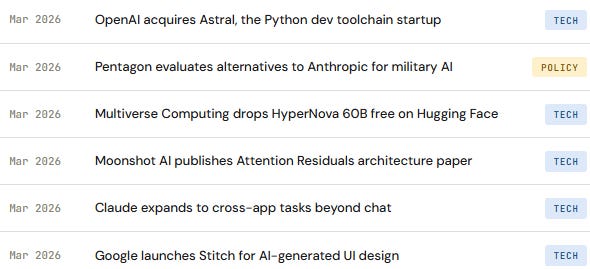
OpenAI moves deeper into developer tools with Astral deal

OpenAI is acquiring Astral, a startup behind widely used open-source tools for Python developers. The Astral team joins Codex, OpenAI’s coding platform, which now counts over 2M weekly active users, up 5x since the start of the year.
Astral’s tools handle dependency management, code formatting, and type checking. OpenAI confirmed it will keep supporting the open-source projects post-acquisition.
The move comes as OpenAI races to close ground on Anthropic, which has built strong developer traction with Claude Code. Source: OpenAI
Pentagon rethinks its AI partnerships

The U.S. Department of Defense is evaluating alternatives to Anthropic for its AI needs, according to recent reports.
The friction is specific: Anthropic’s safety guardrails limit how its models can be used in operational military contexts. The Pentagon needs flexibility that Anthropic’s current policies don’t allow.
OpenAI and Google are already embedded in government contracts. With Anthropic potentially stepping back, both are well-positioned to fill the gap.
Why it matters:
AI alignment is no longer just a technical debate. It now determines which companies win billion-dollar government contracts and which ones don’t. Source: TechCrunch
Worth Reading
How to Make AI Sound Like You: Dan Shipper published a practical guide on matching AI output to your actual writing style. "Write in a friendly tone" produces slop. A real style guide with sentence-structure rules, signature moves, and anti-patterns produces writing that sounds human. Read this before you write your next prompt. Read More
World Models: Computing the Uncomputable: Packy McCormick & Pim De Witte The unlock for physical AI isn't better robots, it's better simulation. World Models learn to predict how environments behave, not just words. If they're right, the bottleneck for embodied AGI isn't hardware. It's whether AI can model physics accurately enough in its head. Read More
Agents Over Bubbles
Ben Thompson argues the agentic AI wave is structurally different from prior tech bubbles. The usual pattern-matching about crashes doesn’t apply here, and he makes the case clearly. Read More
Compressed AI: 95% Smaller, Nearly Identical Performance
Multiverse Computing has released HyperNova 60B, a compressed version of OpenAI’s 120B model that cuts memory requirements from 61GB down to 32GB while maintaining near-identical performance.
Its CompactifAI technology can reduce model size by up to 95% with only 2-3% accuracy loss, compared to the industry standard of 20-30% accuracy loss after just 50-60% compression. The model is available for free on Hugging Face.
Also Read
Claude goes beyond chat : Claude can now take on tasks across different apps and workflows, not just within chat.
AI robots assist U.S. Navy ship maintenance : AI-powered robots are being used to inspect and maintain naval ships, reducing manual effort and improving efficiency.
Google introduces Stitch for AI UI design : Google’s Stitch lets users turn prompts or images into full UI designs and front-end code in minutes.
Microsoft hires Cove team for AI collaboration push : Microsoft has acquired talent from AI collaboration startup Cove to strengthen its AI product suite.
OpenArt introduces AI-generated 3D worlds : A new tool allows users to generate fully navigable 3D environments from a single prompt.
Meta is having trouble with rogue AI agents
Tweet of the Week


A major flaw in AI architecture?
Every AI you use today: ChatGPT, Claude, Gemini, blindly stacks layer outputs on top of each other with no filtering. The earliest, most important patterns get drowned out as the model gets deeper.
Moonshot AI (Kimi) just published a paper called Attention Residuals, where each layer votes on which previous layers actually matter instead of inheriting everything equally.
The results: performance matching models trained with 25% more compute, tested on 48 billion parameters, with less than 2% inference slowdown. Read Paper
Worth a Try AI Tools
An all-in-one AI podcasting platform that lets creators record, edit, generate social clips, and publish, without leaving the app.
Why try it?
Ideal for quickly turning ideas into polished podcast content.
NVIDIA’s framework for building AI agents with built-in safety guardrails. It gives developers structured controls over how agents behave, what they can access, and how they escalate decisions.
Why try it?
Useful for developing controlled, secure AI agent workflows.
Before You Go
Three stories this week, and I keep coming back to the same one. Not the acquisition, not the compression benchmark. The Pentagon is quietly shopping for a more compliant vendor.
It’s a small story in terms of word count. It’s a big story in terms of what it means for labs that decided safety was non-negotiable. I don’t have a clean answer on that. But it’s the question I’ll still be thinking about.