

February 27, 2026
Safety principles got their first real stress test this week. With real money attached.
The U.S. military gave Anthropic an ultimatum: drop your safety limits or lose $200 million. Anthropic said no.
That was the week’s sharpest moment, but not its only one. Three Chinese AI labs allegedly ran 24,000 fake accounts to extract 16 million Claude queries. India closed $250 billion in AI infrastructure pledges. Perplexity, Manus, and Google each launched agent systems that don’t just answer questions, they finish tasks.
The pattern: AI isn’t just getting smarter, it’s getting contested. Every major story this week is about who controls AI, what it’s allowed to do, and who gets to build with it.
TIMELINE - This Week
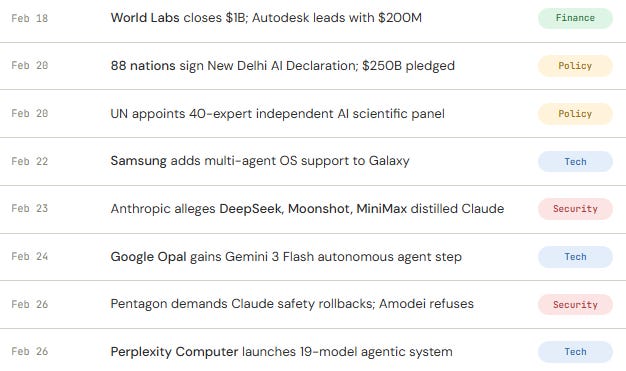
MAIN STORIES
When the Pentagon Says Jump, Anthropic Said No
The U.S. Department of Defense gave Anthropic a hard deadline: loosen Claude’s safety restrictions for military use, or face a canceled $200 million contract and a formal “supply chain risk” designation. CEO Dario Amodei refused publicly on February 26, saying the company “cannot in good conscience” allow Claude to enable mass domestic surveillance or fully autonomous weapons without human oversight.
This is the first time a major AI lab has publicly refused a direct government ultimatum on safety grounds. How it resolves will set a precedent for every lab with a defense contract.
Source: The Guardian
The AI Heist: 24,000 Fake Accounts, 16 Million Queries
Anthropic accused three Chinese AI firms — DeepSeek, Moonshot AI, and MiniMax — of using 24,000 fraudulent accounts to extract roughly 16 million queries from Claude. The alleged technique is “model distillation”: feeding a competitor’s outputs into your own model to absorb capabilities without building them independently.
If the claims hold, this is industrial-scale IP theft. It also signals that winning the AI race doesn’t always require better research.
Source: Anthropic’s Official Statement
AI Stopped Searching. It Started Doing.
Three launches this week moved AI from answering questions to taking action. Perplexity unveiled “Perplexity Computer,” orchestrating 19 models to handle multi-step workflows on your behalf. Manus (acquired by Meta for roughly $2 billion) launched personal agents inside Telegram with persistent memory. Google added a self-running agent step to Opal, powered by Gemini 3 Flash.
The shift matters for everyday users most. Search tells you what to do. Agents do it for you.
Source: Perplexity Official Statement
$250 Billion and 91 Signatures: The Global South’s AI Bet
India’s AI Impact Summit closed with $250 billion in infrastructure commitments and 91 countries signing the New Delhi Declaration. The US, China, Russia, and the EU were all in the room.
The signal isn’t just the money. Countries outside the traditional AI powers are choosing to build infrastructure rather than rent it. Sovereign AI is becoming foreign policy.
QUICK HITS
World Labs Raises $1 Billion — Fei-Fei Li’s spatial intelligence startup closed a $1B round backed by Nvidia, AMD, and Autodesk. The goal: “world models” that understand and generate interactive 3D environments for robotics and gaming.
ALSO READ
The UN Created an AI Science Panel. The US Said No. Forty researchers were appointed to the UN’s Independent International Scientific Panel on AI this week. Their mandate: give governments honest risk assessments, no vendors in the room. The US voted against it. The official reason was overreach. Draw your own conclusions.
Samsung Turned Your Phone into an AI Switchboard : Galaxy phones are getting multi-agent support baked into the OS. Different tasks, different agents, one device. You pick which AI handles what. Samsung does the routing. It’s a quiet but real shift: the phone becomes the hub, and no single AI app owns your workflow.
WORTH A TRY
Claudebin (Feb 20) : You finish a Claude Code session. The thinking is good. The workflow is repeatable. And then it disappears into a terminal window nobody else can see. Claudebin fixes that. It converts your full session, message thread, file reads, web calls, into a link you can share. Teams use it to hand off work. Educators use it to show process, not just output. Worth keeping in your toolkit. Link - claudebin.dev
Nano Banana 2 (Feb 26) : Google’s new image model isn’t making headlines for quality alone. It’s fast. Noticeably fast. If you’ve sat waiting on Midjourney or Flux during a high-volume creative sprint, you’ll feel the difference. The output holds up. The wait doesn’t. Google Labs
DEEP READ
AI Is Replacing Your Analytics Stack: MIT researchers put out a paper this week with a simple, uncomfortable argument: large language models aren’t just writing tools. They’re becoming the layer through which companies process large, unstructured datasets. The analyst workflow, specifically. Not all of it, but enough that it’s worth understanding the architecture before it shows up in your org chart. Download PDF — free
The Skills Gap Isn’t Closing on Its Own: The OECD published a brief on global AI upskilling this week. Most of these read like policy theater. This one doesn’t. It’s specific about where programs are working and blunt about what organizations keep getting wrong. If you’re making decisions about your team’s AI readiness, or just your own, read the second half first. Download PDF — free
Before You Go
The Anthropic story and the distillation accusations are easy to read as separate events. They’re not. One is about what AI companies will do when governments push on safety. The other is about what competitors will do when the research gap feels too wide to close honestly. Both are about pressure finding the path of least resistance.
Anthropic held publicly this week. Most labs will face quieter versions of the same choices and won’t issue a statement about it.